
Reimagining Spaces for Care: Key Insights for Adaptive Reuse in Healthcare
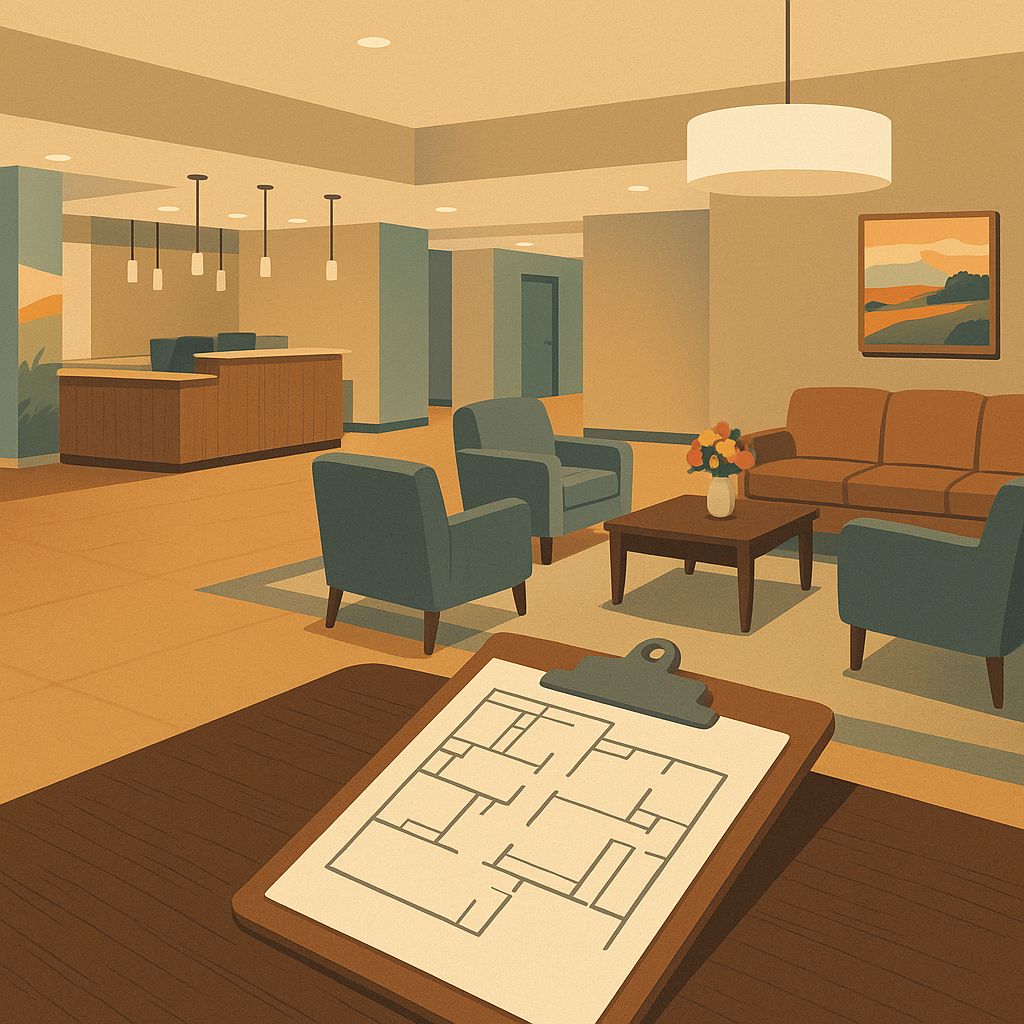
Reimagining Spaces for Care: Key Insights for Adaptive Reuse in Healthcare
Across the country, healthcare providers are increasingly turning to adaptive reuse — transforming existing commercial buildings such as hotels, offices, or schools into clinical environments. For behavioral health organizations in particular, this approach offers a compelling balance of speed, cost efficiency, and sustainability.
Repurposing an existing structure can shorten construction timelines, reduce upfront capital needs, and help meet growing demand for services in communities that need them most. But the path from “available building” to “ready-to-serve facility” is rarely straightforward. Hidden infrastructure gaps, outdated systems, and code compliance issues can quietly turn an otherwise promising opportunity into a costly undertaking.
That’s why engaging engineering and design experts early — ideally before a lease is signed or a purchase is finalized — is one of the most valuable steps in the development process. Early technical assessments not only protect budgets and timelines, but also position operators to make informed, strategic decisions about long-term facility performance.
Below are three critical questions every healthcare decision-maker should address with their engineering and design partners before embarking on an adaptive reuse project.
1. What will it take to adapt this space to clinical use?
Underestimating infrastructure requirements is among the most common and costly pitfalls in adaptive reuse.
Older buildings often lack the mechanical, electrical, and plumbing (MEP) systems necessary to support healthcare operations. Behavioral health and substance use disorder facilities, for example, require specialized HVAC systems, extensive plumbing for patient rooms and nursing stations, controlled access systems, and lighting that balances safety with a therapeutic atmosphere.
Even if a building appears structurally sound, only a detailed engineering evaluation can reveal whether existing systems are sufficient—or whether major upgrades will be required. Missing this step can lead to awkward design compromises that impact both aesthetics and function.
ZLD Partners has seen this firsthand: facilities that begin with minimal feasibility assessment often face late-stage redesigns when ceiling heights, duct runs, or electrical capacities don’t align with medical or safety standards. These oversights can delay openings, complicate licensure, and diminish the patient and staff experience.
The goal isn’t just to confirm what’s possible—it’s to define what’s practical and sustainable for the facility’s long-term use. That includes evaluating expansion potential, future system loads, and maintenance access from day one.
2. How will building codes and healthcare standards affect the plan?
Healthcare facilities are governed by more stringent codes than typical commercial spaces. Requirements related to fire protection, medical gas, air exchanges, infection control, and life safety can differ significantly by jurisdiction and facility type.
In the post-pandemic landscape, many states have tightened standards for ventilation, backup power, and emergency preparedness. Behavioral health facilities must also consider additional layers of regulation from The Joint Commission (TJC), CMS, and state licensing agencies—all of which shape how spaces are designed, constructed, and maintained.
For instance, new versions of the National Fire Protection Association codes (NFPA 99 and NFPA 101) now include expanded provisions for HVAC redundancy, medical gas connections, and patient-safety features. Local building departments may also adopt updated energy or life-safety codes that substantially alter construction budgets.
An experienced engineering partner can map out these requirements early, identifying potential conflicts before they become change orders. Early coordination ensures the design team, contractor, and licensing body are aligned—saving time and protecting the project’s regulatory path to occupancy.
3. What are the hidden costs and long-term challenges?
A facility may look ready for conversion, but without a detailed condition assessment, unseen deficiencies can upend even the best-laid plans.
A formal facility condition assessment (FCA) evaluates the integrity and capacity of a building’s core systems—HVAC, electrical, plumbing, and structural components—against healthcare demands. This data enables owners to develop accurate budgets, sequence upgrades, and anticipate lifecycle costs.
The investment in an FCA is small compared to the financial and operational risks of proceeding without one. Unexpected structural reinforcements, undersized mechanical systems, or outdated electrical panels can each translate into six-figure cost adjustments. Beyond the immediate project, the findings from an FCA can inform future expansion strategies and capital planning, strengthening organizational foresight.
Building Smart, Building Early
Adaptive reuse offers a viable, cost-effective path to expand healthcare access—particularly in behavioral health, where community need often outpaces new construction. Yet the success of these projects depends on recognizing hidden challenges early and aligning technical expertise with operational vision.
By integrating engineering insight at the due-diligence stage, healthcare developers and operators can avoid expensive surprises, accelerate their speed to market, and ensure that each facility functions safely, efficiently, and therapeutically.
At ZLD Partners, our work begins well before construction starts. We believe the best projects are built on clarity—clarity about infrastructure, compliance, and the operational realities that turn a building into a healing environment.
Bottom line: Involve your engineers early. It’s not just a design decision—it’s a strategic one.
