
Plato’s Trauma Cave: The Neuroscience Behind the Philosophical Metaphor and Behavioral Health Busines
There’s a story I often return to when working with clients who have experienced trauma. It isn’t from a psychology textbook or a clinical manual, but from the ancient Greek philosopher Plato’s Republic – Book VII, to be exact.
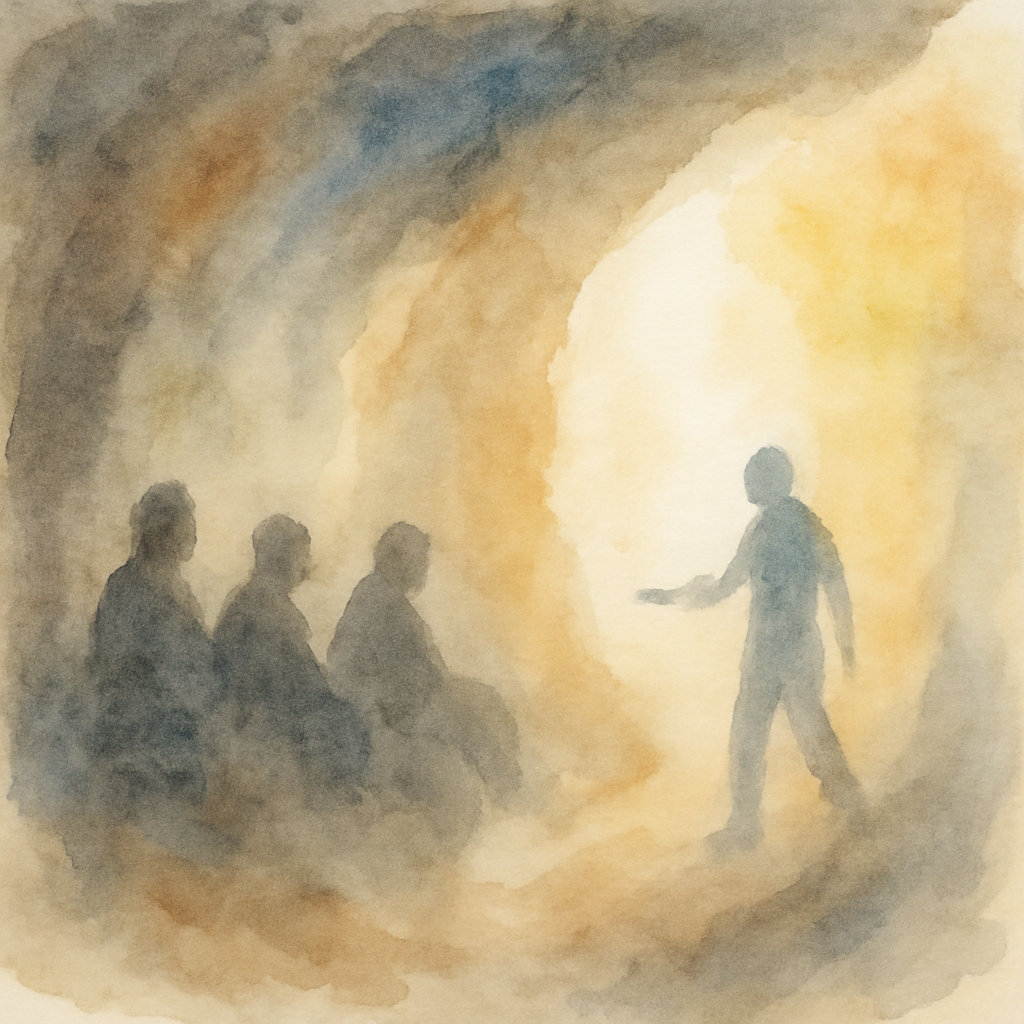
Plato describes a group of people living inside a dark cave, chained so they can only face the wall. Behind them is a fire. As objects pass in front of the fire, shadows move across the wall, and those shadows become the prisoners’ entire world.
Now imagine someone unchaining one of them and pulling them outside. The sunlight would feel blinding. The colors, the shapes, the open space – too much, too fast. It wouldn’t feel like freedom. It would feel like pain.
This is what trauma can feel like.
When people have experienced trauma, their brains adapt to survive.
This isn’t symbolic – it’s biological.
Repeated exposure to threat conditions the nervous system to prioritize protection over exploration, which directly maps onto Plato’s cave metaphor.
Neurologically speaking, the amygdala, the brain’s alarm system, becomes hypersensitive and interprets neutral experiences as potential danger. The hippocampus, which organizes memory and context, can shrink under chronic stress, making it harder to distinguish past threat from present safety. The prefrontal cortex, responsible for reasoning, reflection, and insight, temporarily goes offline when survival circuits activate.
In other words:
Trauma literally trains the brain to believe the shadows are real.
So, the “shadows on the wall” become deeply embedded beliefs:
- “Trust is dangerous.”
- Reality: Trust isn’t a choice; it’s a physiological state.
For trauma survivors, the nervous system has learned that closeness and vulnerability often lead to pain, abandonment, or unpredictability. Their body signals danger long before their mind has a chance to interpret the moment. Trust grows only when the body repeatedly experiences safety, consistency, and attunement – not through encouragement or logic.
- Reality: Trust isn’t a choice; it’s a physiological state.
- “If I let my guard down, I’ll get hurt.”
- Reality: This belief forms when danger occurred during moments of openness, calm, or innocence.
The body encodes a rule: “Safety requires vigilance.”
Dropping the guard doesn’t feel relaxing – it feels reckless.
Therapeutic work must help clients experience regulated safety long enough for their defensive systems to recalibrate.
- “The world is unpredictable.”
- Reality: This isn’t pessimism; it’s pattern recognition.
For many survivors, environments were chaotic, inconsistent, or unsafe. Their nervous system learned to expect instability because instability was normal. Predictability must be experienced, not taught.
Therapy provides micro-patterns of consistency that help the brain update its expectations over time.
- Reality: This isn’t pessimism; it’s pattern recognition.
- “People don’t stay.”
- Reality: Attachment injuries teach that relationships are temporary, conditional, or unreliable. The pain of abandonment conditions the nervous system to anticipate loss as a form of self-protection. The therapeutic relationship offers a corrective experience: a relationship that remains steady, attuned, and present long enough for the body to learn that connection can endure.
- “Opening up means losing control.”
- Reality: Emotional expression was once punished, ignored, or used against them. To the survivor, vulnerability isn’t therapeutic – it’s exposure.
Their system believes that expressing feelings leads to consequences such as, rejection, minimized (emotionally), getting hurt, feeling shamed, being overwhelmed, etc.
The protective response makes perfect sense: “If I stay in control, I stay safe.”
Therapeutic pacing must honor this.
- Reality: Emotional expression was once punished, ignored, or used against them. To the survivor, vulnerability isn’t therapeutic – it’s exposure.
The above examples are more personal in nature, but you can insert various negative core beliefs to fit a business setting example. Such as:
- “Good leaders should have all the answers.”
- Reality: Effective leadership is collaborative, curious, adaptive or ever evolving as I often put it.
Believing you must be the expert makes you avoid acknowledging vulnerability, exploring consultation, and accountability.
- Reality: Effective leadership is collaborative, curious, adaptive or ever evolving as I often put it.
- “If I look uncertain, people will lose confidence in me.”
- Reality: Authenticity builds trust. Pretending creates distance and mistrust.
Teams can feel when leaders mask insecurity – and they’ll mirror it.
- Reality: Authenticity builds trust. Pretending creates distance and mistrust.
- “Being busy means being productive.”
- Reality: Chronic urgency is a symptom of disorganization, not effectiveness.
Leaders stuck in this shadow confuse movement with progress.
- Reality: Chronic urgency is a symptom of disorganization, not effectiveness.
- “Staff resistance means they don’t care.”
- Reality: Resistance is usually fear, overwhelm, or lack of psychological safety.
It’s an autonomic response, not a moral failing.
- Reality: Resistance is usually fear, overwhelm, or lack of psychological safety.
- “If people aren’t complaining, everything is fine.”
- Reality: Silence often means “I don’t feel safe enough to tell the truth.”
The most dysfunctional cultures are frequently the quietest.
- Reality: Silence often means “I don’t feel safe enough to tell the truth.”
- “We’ll just create policies to fix our problems.”
- Reality: Policies codify culture – they don’t replace it.
Systems drift when leaders rely on paperwork more than presence.
- Reality: Policies codify culture – they don’t replace it.
Every business leader and clinician should periodically ask themselves the question:
“What shadows do I trust without questioning?”
These aren’t irrational thoughts.
They are neurological survival strategies.
When people in therapy are asked to suddenly face light – to be vulnerable, reflective, or curious – it can overwhelm the nervous system. Insight requires a regulated brain, and many clients have never known what regulation feels like… It can feel scary, wrong, and unnatural.
Why We Can’t Rush the Light
Trauma therapy is often described as helping people move toward healing and understanding. But readiness for insight isn’t psychological – it’s physiological.
If a client’s body is still in a defensive state, cognitive work feels like being dragged into the sun.
Common signs of “too much light, too soon”:
- Emotional flooding
- Shutdown or dissociation
- Flat affect
- Anger or withdrawal
- Intellectualizing instead of feeling
- “I don’t know” responses
- Missed sessions or “forgetting” homework
These are not evidence of defiance.
These are the body’s attempts to stay safe and can often cause the client to avoid seeking further therapeutic help all together.
The nervous system doesn’t care about insight until it feels secure.
This is why trauma treatment frameworks – from polyvagal theory to EMDR to TF-CBT – begin with stabilization and regulation.
Safety first. Insight later.
Meeting Clients Inside the Cave
To meet someone where they are means entering their internal environment rather than pulling them out of it.
It looks like:
- Helping them notice signals from the body before exploring signals from the mind
- Normalizing the protective strategies that once kept them alive
- Allowing trust to form slowly and experientially
- Using pacing, not pressure
- Focusing on the window of tolerance over the treatment timeline
Therapy begins with co-regulation.
Two nervous systems learning to occupy the same space safely.
Only when the body feels safe does the mind become curious.
Healing does not begin with light.
It begins with presence.
The Clinician’s Role
Plato writes that if the freed person returns to the cave to help others, those still inside may reject him.
Not because they don’t want help – but because the outside world feels inconceivable.
It’s the same clinically.
We are not fixers, heroes, or rescuers.
We are regulated nervous systems offering a different experience of connection.
We don’t convince people the world is safe.
We help them feel safe enough to test the possibility.
The therapist is not the one with the light.
The therapist is the one who helps clients remember they can walk.
Leadership and Operations: The Cave Exists There Too
This metaphor extends far beyond clients.
It applies to teams, staff, and entire organizations.
Neuroscience doesn’t stop at the therapy room.
Staff nervous systems respond to leadership the same way clients respond to clinicians.
When leaders introduce sudden change, new protocols, or rapid expansions, teams may react like trauma survivors:
- Hypervigilance
- Withdrawal
- Resistance
- Silence
- Cynicism
Most “resistance to change” is actually an autonomic response to uncertainty.
Just like in therapy, organizational growth requires:
- Transparency
- Regulation
- Pacing
- Co-regulation through leadership presence
- Shared language and shared power
- Trust-building before transformation
A staff that feels unsafe will cling to the shadows of the familiar, even if the familiar is dysfunctional.
A staff that feels safe will walk toward the entrance willingly.
Leadership is not about pushing people into the light.
It is about creating systems where the light doesn’t feel dangerous.
A Reflection to Put into Practice
Understanding these distorted “shadows” is only useful if you can do something with the insight. Awareness without practice usually fades by Monday morning. So here are three concrete ways to integrate this reflection into your daily work, team culture, or leadership habits:
- Pick One Shadow You Recognize and Track It for One Week
Choose the belief that felt closest to home
For the next 7 days, notice moments when that belief tries to run the show.
Write down:
- What triggered it
- What the shadow-belief told you
- What the actual reality was
- What choice you made
This turns the reflection into a micro self-study – a way of bringing light into the cave instead of just admiring the metaphor.
- Create a One-Sentence Counter-Statement for Each Shadow
Shadows thrive on vagueness. They feel absolute.
Your job is to collapse the illusion with precision.Encourage yourself to repeat the statement every morning for a week.
It’s simple, but it rewires how the brain anticipates threats. - Practice One Behavioral Action That Directly Opposes the Shadow
Insight alone doesn’t change neural pathways; behavior does.
- If the shadow is mistrust, practice delegating one small task this week.
- If the shadow is hypervigilance, take one calculated risk (e.g., ask for help, say no, or share one honest concern).
- If the shadow is fear of unpredictability, identify one process to tighten or one routine to improve.
- If the shadow is abandonment fear, choose one relationship to test through healthier boundaries or direct communication.
In Closing
Plato’s cave is ultimately a story about perception, possibility, and the courage to move slowly.
It mirrors what neuroscience has confirmed: people do not change through force. They change when they feel safe enough to explore.
In both therapy and leadership, the responsibility is the same:
Not to overwhelm people with light, but to walk with them toward it at a pace their nervous systems can tolerate.
Growth – clinical or organizational – only happens if safety comes first.